
Nonprofit Kita operator in Düsseldorf
About PRI & PRI KITA
PRI & PRI KITA gemeinnützige GmbH is a nonprofit operator of day-care centres in Düsseldorf. This page explains who we are, how we are structured, and the principles we hold to when we take responsibility for a Kita.
Legal form and what it changes
A charitable purpose is written into the company, not just stated on a page.
We are a gemeinnützige GmbH, a nonprofit limited company under German law. That legal form matters more than it sounds. It means the company has a charitable purpose, profits cannot be distributed to shareholders, and any surplus has to go back into the work.
For a Kita, this is not a technicality. It means decisions can be made around children and staffing rather than around returns. Where a commercial operator answers to owners, a nonprofit Träger answers to its purpose and to the city that licenses the place.
The company is registered in Düsseldorf under HRB 82607. That registration is public, and it is one of the first things a partner or a parent can check when they want to know who is behind a Kita.
Leadership
Managing Director
Eleni Tzioka
Carries legal and organisational responsibility for PRI & PRI KITA gemeinnützige GmbH, including contracts, staffing frameworks and the relationship with the city.
In a Kita organisation, the managing director carries legal and organisational responsibility: contracts, staffing frameworks, compliance with youth welfare requirements, and the relationship with the city.
That responsibility is not delegated to the individual Kita alone. It sits with the Träger. If a centre is short-staffed, if a room does not meet requirements, or if a family cannot get a clear answer, the question belongs with us and not only with the team on site.
It is why the leadership of a Kita operator is a fair thing for parents and partners to look at. Who signs, who is accountable, and who can be reached are part of the service, not internal detail.
Our mission, stated plainly
We manage and support Kindertagesstätten in Düsseldorf. That is the whole mission. It sounds modest, and it is meant to. A Kita does not need a grand narrative; it needs reliable structures, trained staff, clear communication with families, and someone accountable when something is not working.
Our role is to provide that framework so the pedagogical work has room to happen. Management covers the parts a parent should never have to think about: contracts and staffing plans, safe premises, hygiene and safety routines, budgets, and reporting to the Jugendamt. Care covers what a child actually experiences: a stable group, familiar adults, a day that has a rhythm, and time to play without being hurried.
Both halves have to hold at once. A well-managed house with tired, changing staff is not a good Kita, and a warm team without reliable structures will struggle eventually. We work on the pair together.

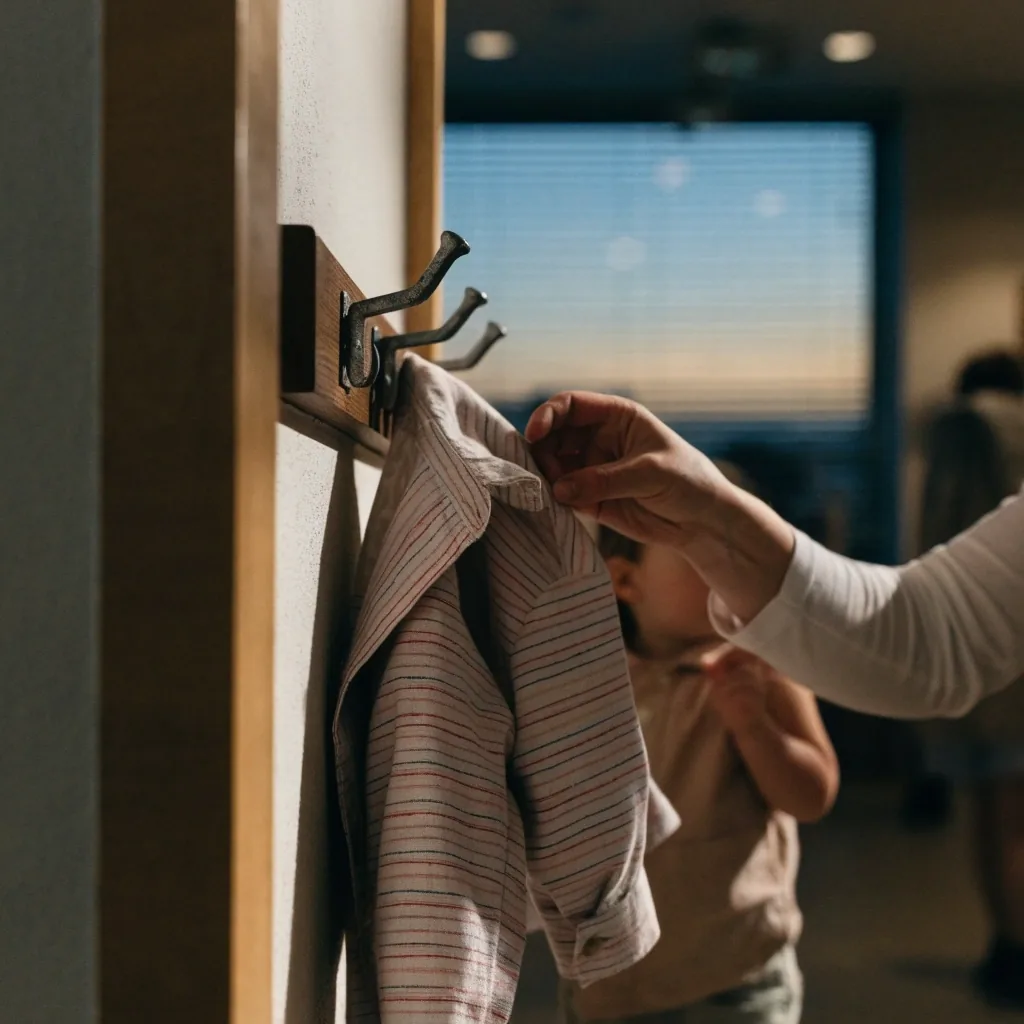
Coat pegs at child height, one per place in the group.

Outdoor shoes at the door, the daily transition between garden and group room.

Rest blankets folded and ready on the shelf before quiet time.

A chalk line on the courtyard wall, left from the morning's play.
Stable staffing
Care work is skilled work. It deserves contracts that hold, rosters that are planned ahead, and educators who are not rotated through a house every few months.
Families as partners
Parents are partners in a child's day, not customers to be managed. Drop-off and pick-up are conversations, and a question deserves an answer from someone who knows the child.
Clear communication
Communication should be clear enough that a parent does not have to guess what is happening. When a centre has a problem, the Träger is responsible for addressing it, not for distancing itself from it.
These are not slogans; they are the lines we are judged against.
How we work with the city
Düsseldorf organises childcare through the Jugendamt, the Kita-Navigator and family services such as i-Punkt Familie. A Träger operates inside that system rather than beside it. We register capacity, cooperate on place allocation, follow the city's requirements for staffing and premises, and take part in the processes that keep a Kita licensed.
Parents feel this indirectly. It is why enrolment runs through the city's tool rather than a private form on our site, and why opening hours and group structures follow city norms instead of whatever suits an operator's schedule. When a place is offered, it is offered inside a shared system that other families are also using.
It also means the sequence is predictable: register your child with the city, look at the centres that fit your situation, then contact us about the ones you are considering. We explain the full route on the enrolment page.
Nonprofit status does not make anyone perfect. It changes what the decisions are for.
Why nonprofit matters in childcare
Childcare is a public responsibility in Germany, and nonprofit providers are part of how that responsibility is carried. A gemeinnützige Träger is accountable to its purpose, not to investors. In practice, that shapes priorities: staffing continuity, fair working conditions for educators, and long-term stability of a location rather than short-term optimisation.
It also sets the boundary of what we can do. We cannot conjure places that do not exist, and we cannot promise a specific Kita to a specific family. What we can do is keep the houses we run in good order, answer honestly about capacity, and stay reachable when a family has a concern.
The broader Düsseldorf childcare landscape
We operate in a city with many providers: municipal Kitas, church-run houses, large welfare associations, parents' initiatives and independent operators. Diakonie Düsseldorf alone runs dozens of Kitas with family centres attached. This density is good for families because it means choice, and it is demanding for operators because it means comparison.
A nonprofit Träger has to be clear about what it does and honest about what it cannot do. The questions worth asking are the same at every provider: who is accountable for the house, how stable is the team, how does the centre communicate with parents, and what happens when something goes wrong. Our answers are on this page and on the services page, and we would rather be asked than assumed.
Municipal Kitas
Run directly by the city, with the Jugendamt as the operator and a place allocation handled through the same city-wide process.
Welfare associations
Large nonprofits such as Diakonie run many houses with family centres attached, and often carry decades of regional experience.
Independent and parent-led
Parents' initiatives and smaller independent operators, usually close to a neighbourhood and shaped by the families who founded them.
Transparency and accountability
A Kita operator should be findable and answerable. Our address is Vagedesstraße 19, 40479 Düsseldorf. The company is registered under HRB 82607, and the Managing Director is Eleni Tzioka.
If you have a question about how a centre is run, or about our role as Träger, you can reach the office by phone on 996513769 or by email at [email protected]. We would rather answer a direct question than have it circulate unanswered.
The office is staffed Monday to Friday, 7:30 AM to 5:00 PM. If you are already working with one of our centres, the team there is usually the fastest route; for anything about the Träger itself, call or write to us directly.
Office
Monday to Friday
7:30 AM – 5:00 PM
Saturday and Sunday
Closed
Questions we are asked
Short answers to the things parents and partner institutions ask most often. If your question is not here, the FAQ page goes further, and the office answers by phone or email.
What kind of organisation is PRI & PRI KITA?
A gemeinnützige GmbH registered in Düsseldorf under HRB 82607, led by Managing Director Eleni Tzioka. We manage and support Kindertagesstätten in the city as a nonprofit Träger.
Can I apply for a Kita place directly with you?
Places are allocated through the city's Kita-Navigator, not through a private form here. Register your child with the city first, then contact us about the centres you are considering.
What does the Träger actually take responsibility for?
Contracts, staffing frameworks, premises, compliance with youth welfare requirements, and the relationship with the city. Day-to-day pedagogy belongs with the team on site; the structure that makes it possible belongs with us.
How can I raise a concern about a centre?
Start with the team at the centre, since they usually know the situation. If that does not resolve it, contact the office by phone on 996513769 or by email at [email protected] and we will take it up.

Come and see how we run a Kita
The services page covers management and care in detail. If you are a parent comparing providers, or an institution looking for a Träger to work with, the office is the right place to start.